Crypto recovery costs: the four fee models, a fair quote and the red flags
Published: Last reviewed: How we edit
Hard truth: crypto recovery help has no standard price. Quotes come in four shapes: a fixed fee for a defined job, an hourly rate, a cut of whatever is recovered, or a retainer. A fair quote is written down, names who does the work, says what counts as recovered and lists exclusions. The US Federal Trade Commission's advice is blunt: if a stranger offers to recover scam losses, do not pay.
Got a question about your case? Ask us here:
Why no standard price exists
Cost follows the job. A letter to an exchange, a blockchain trace, a court report and a legal claim are different pieces of work with different prices. The sum at stake, the country and the number of parties all change the effort too.
The outcome sits in someone else's hands. An exchange, issuer, bank or court decides, and no provider controls that. So an honest provider prices its work and time, and says up front that no result is promised.
Here, the assessment comes first and costs nothing. Before fees are even discussed, we state in writing whether we can help, and only then quote a fee model. Independent lawyers and specialists set their own fees, shown to you separately before you agree.
The four fee models you will meet
Nearly every quote falls into one of four models, and some blend them. Any of them can be fair when it is written down and explained. Any of them can also hide trouble when the terms stay vague.
Compare the models in the table, then take the questions in the last column with you. Those answers matter most: a provider that commits to them on paper is much easier to hold to account.
| Model | How it works | Main risk for you | Ask before you agree |
|---|---|---|---|
| Fixed fee | One set price covers a defined task, such as a report or a formal letter. | You pay even when the platform or authority says no. | What exactly do I get, and how is any extra work priced? |
| Hourly rate | You are billed for time spent, normally against an estimate. | A case that drags on makes the total grow. | How big is the estimate, can the total be capped, and do I get a log of hours? |
| Percentage of recovered value | The provider keeps a share only when funds come back. | A fuzzy definition of 'recovered' can leave you paying on money that would have reached you anyway. | How is 'recovered' defined, does the cut come before or after costs, and who is holding the money? |
| Retainer | You deposit an amount first, and fees are billed against it as work proceeds. | Funds are with the provider long before any result is known. | Where does the retainer sit, what is charged to it, and what comes back if I walk away? |
| Upfront payment demanded by an unsolicited sender | The sender wants payment first and explains the work later, if ever. | Recovery scams often follow this pattern, and the payment may be gone for good. | Do not pay. Compare the offer with the red flags further down, and request a company registration number. |
What providers print about their fees
We went through the public websites of 195 providers and related companies in November 2026. Plenty of them skip the question of how they charge. A small minority at most commit to results online, and that matches reality: no provider controls the decision.
Where a percentage is printed at all, the median in our review sits near 20 percent. Just 32 sites print one, so take it as a rough marker, not a price list. These figures show what sites say about themselves. They say nothing about what clients pay or how the work turns out.
Take it as a yardstick, nothing firmer. The complete review sits in the research section of this site. Whatever the provider, get the fee model on paper before any money moves.
Your checklist for a fair quote
Good quotes are specific and written. You should be able to read yours twice, hand it to a friend or lawyer, and still understand what you are buying. Take your time, and ignore any deadline that pushes you to pay today. Demand every item below on paper first.
- The company's legal name and registration number, which you can check yourself in an official register.
- A written scope covering what gets done, by whom, what you receive and what is excluded.
- Who the independent lawyers or analysts are, and whether they bill separately.
- How fees work: a total or a ceiling, and when each payment falls due.
- If a percentage applies, a plain definition of 'recovered' that covers costs and who holds the funds.
- What becomes of money you have already paid when the platform or authority refuses.
- An exit at every stage, so the next payment is never forced on you.
Red flags that mean stop
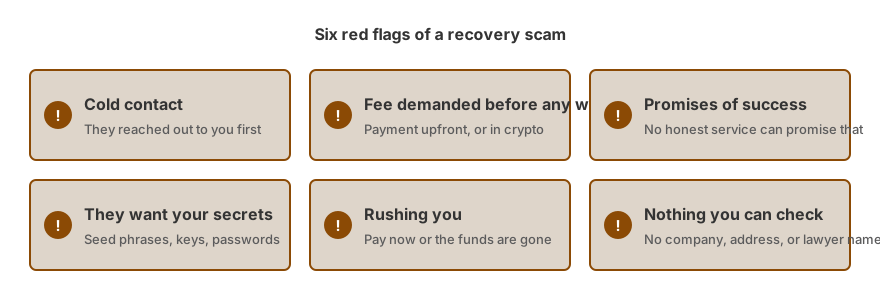
Any single warning sign could be innocent. Pile several up and it is time to stop. According to the US Federal Trade Commission, you should not pay a person who approaches you with an offer to recover scam losses, and gift cards, crypto and wire transfers are payment methods that only scammers insist on.
Kraken's help page on scams describes offers to recover lost funds as almost always a second scam, often with an upfront fee. When two or more signs below fit, stop paying and run the offer through the recovery scam check tool on this site. A seed phrase, private key or password goes to nobody, whatever the reason given.
- They reached out first, often right after you posted about your loss.
- Money is wanted before anyone says if help is possible, or 'release' fees, taxes and deposits show up afterward.
- A result, a date or a fixed portion of your funds is promised.
- You are asked for a seed phrase, private key, password, or control of your device remotely.
- Payment is accepted solely as crypto, gift cards or transfers into a personal account.
- They cannot name a registered company, lawyers or a written scope.
- They push a deadline or tell you the chance ends today.
Getting help without paying first
Some routes cost nothing. In most places, a scam report to the police or a national fraud service is free, and the FBI's IC3 states that genuine law enforcement does not bill for its services. Your bank, card provider or exchange can say what it needs from you. Many exchanges run a no-cost review or appeal, and where a regulator or ombudsman exists, it may accept a complaint free of charge.
Paid help deserves a look if the sum is large, the facts are tangled, or you need a formal letter, report or claim. Then request our free assessment. You get a written answer on whether we can help, and the fee model arrives in writing before any payment. Exchanges, issuers and courts make their own calls, which we cannot alter. No seed phrase, private key or password is ever requested by us.
Frequently Asked Questions
Does a percentage fee point to a scam?
No. Plenty of honest providers take a share because the outcome is uncertain. Read the contract: it should define recovery, state whether costs come off first and say who holds the money. What should alarm you is a payment demanded upfront by somebody who contacted you first.
Is a lawyer's retainer normal?
In many places, yes. Lawyers commonly take an advance and bill against it while they work. Request a written engagement letter, confirm the lawyer in the official bar register on your own, and ask what is refunded if you stop. Disregard any contact details sent by whoever approached you.
Do I get my fees back if the platform refuses?
That hangs on the written agreement, so ask before signing. With a fixed or hourly fee you often pay for work done, whatever the result. With a percentage fee you usually pay only if funds come back. Ask what is refunded if you stop.
Is there any way to recover lost crypto at no cost?
Sometimes. A quick report, a clear appeal to the platform and tidy records cost nothing, and they are the first steps in most cases. Whether funds return depends on where they are and who can act. Nobody can promise a result, and paying does not change that.
How can I tell if an offer is a scam?
Check it against the red flags in this guide: the provider contacted you first, wants a fee upfront, promises a result, asks for a seed phrase or remote access, or has no registered company you can verify. Our recovery scam check tool poses ten questions and shows which warning signs apply.
Is your first assessment truly free?
Yes. It costs nothing, and we reply in writing on whether we can help before money comes up. Should we take the case, the scope and fee model follow on paper. Independent lawyers and specialists quote separately. Stopping is always your choice.
How we can help
- Help after a crypto scam. Steady help after a crypto scam: assess, document, trace, send freeze requests.
- Who froze my crypto? A freeze diagnosis. Name who froze your funds, then see what can realistically be done.
- Tracing stolen crypto, sending freeze requests. Trace stolen crypto, request freezes at exchanges and issuers, file a police report.
- Unblocking an exchange account. Decode the freeze, build KYC/AML evidence, answer compliance, file the appeal.
Sources
These come from official or authoritative pages. Since pages can change, verify the current wording at the source.
- Worried about crypto exchange losses? Don't pay money for help recovering money · US Federal Trade Commission
- Crime information: Cryptocurrency · FBI Internet Crime Complaint Center (IC3)
- Can I recover crypto lost to a scam? · Kraken
Everything on this page is general information. It is not legal advice.