Your USDT address is frozen: what a Tether freeze means and your options
Published: Last reviewed: How we edit
If your address holding USDT gets frozen, the tokens still show on the blockchain but they cannot be sent. The freeze happens at the token level, not through your wallet app or an exchange. Typical triggers are a law enforcement request or a compliance flag. Only whoever placed the freeze, or a court, can remove it. Switching wallets or paying a stranger changes nothing.
Got a question about your case? Ask us here:
What a frozen USDT address really means
USDT is a token put out by a company, and the contract was written so the issuer can block chosen addresses from sending or receiving it. If that switch gets flipped on your address, the balance still appears on a block explorer. The tokens simply cannot move out.
That is not the same as an exchange locking your account. An exchange only runs its own platform. A token level freeze sticks to the address itself, no matter where you try to move the funds. A new wallet app, a new device or another exchange will not get around it.
How to check that the freeze is genuine
Plenty of people watch a transfer fail and jump to the worst conclusion. A failed transfer can also trace back to network fees that are too low, the wrong network or a wallet bug. Check the facts before you act on any theory.
Here is the first step: search your address on the public block explorer for your network. Explorers frequently display a flag or label on restricted addresses, and a reverted transaction usually carries a reason code. Screenshot everything, and note the date and time.
- Make sure the network you picked matches the token, for example the network where it arrived.
- Confirm the wallet holds enough of the network's native coin to cover the fee.
- Pull up the address plus your most recent failed transaction on the explorer, then save both.
- Run a very small USDT transfer only once you are certain fees are not the problem. Skip big repeated attempts.
- List every transaction from recent months that touched the address. Note the counterparty and the purpose of each one.
Why addresses get frozen
Freezes are rarely explained case by case. Two patterns come up most often in these situations: a demand from law enforcement, and a compliance flag set off by the issuer or its analytics tools.
With an authority request, the underlying case usually involves somebody else, like a scam or a theft. Your address may have sent funds to, or taken funds from, an address connected to that case. A compliance flag follows the same logic, but it begins with screening instead of a court or police order. Neither pattern means you did anything wrong.
Who holds the power to unfreeze, and who does not
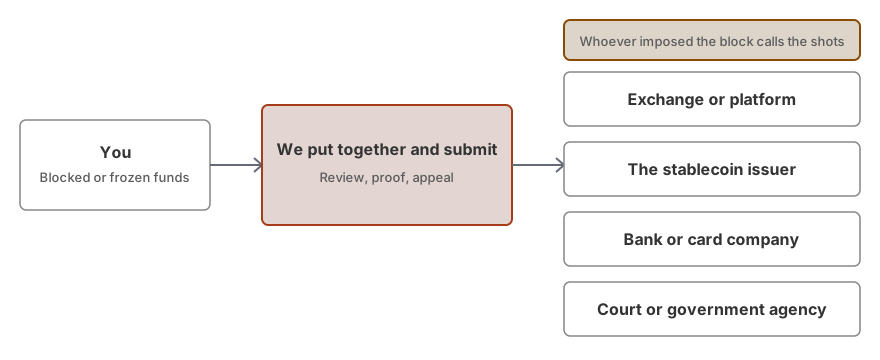
Control sits with whoever holds it, and only that party can remove the restriction. That means the issuer, either after its own review or on the request of the authority that ordered the freeze, or a court.
If your USDT address is frozen, exchanges, wallet providers, block explorers and support teams have no power to undo it. Neither do we. So if someone offers to unfreeze it for a fee while skipping the issuer or the authority, they are either wrong about how this works or trying to sell you something. Here is the plain truth: no magic shortcut exists.
What you can and cannot do
You can reach the issuer through its official support or legal channel, ask which type of restriction applies, and ask what information they need. If you know an authority is involved, you can also have a lawyer write to it.
Nobody can force a faster outcome here. Do not try to dodge the freeze either. Shuffling your other assets through mixers or fresh wallets looks like evasion, and that makes any review harder.
- Save the address itself, screenshots from the explorer, and a complete record showing how the money reached you.
- Collect evidence of where the funds came from: exchange statements, bank transfer records, invoices and signed contracts.
- Reach the issuer only through channels listed on its own website, never through links someone sent you.
- Log every message in writing, including dates and reference numbers.
- Nobody helping you should ever get your seed phrase, private key or password.
A sensible next step
First, put together a one page timeline: when the USDT arrived, who sent it, the reason, and what happened to it afterward. Every issuer, authority or lawyer will ask for this before anything else.
Is a large sum frozen, or do you suspect a legal request sits behind it? Then bring that timeline to a licensed lawyer in the relevant jurisdiction. We review your case for free, organize the evidence and coordinate independent lawyers and analysts. Nobody can promise the address gets released.
Frequently Asked Questions
If my USDT address gets frozen, will my balance still show up?
Yes. Your balance stays visible on the blockchain and in most wallets. What changes is this: the token contract blocks transfers out of that address, so sending, swapping and selling are all off the table.
If an address is frozen, does that mean police are investigating me?
Not necessarily. The freeze might come from a request that concerns someone else whose funds passed through your address, or from an automated compliance flag. See it as a signal to collect your records and get advice. It is not proof of suspicion.
If I switch to a new wallet, will my money unfreeze?
No. The restriction sits on the address itself, so the frozen tokens cannot be moved. A new wallet changes nothing about them, and fresh funds arriving from a flagged address can trigger new questions.
How long does a USDT freeze stay in place?
We cannot give you a fixed period, because none exists. Some holds last as long as an authority works the case, others lift after a review. Ask the issuer which type you are dealing with, and keep your evidence ready.
Can I safely pay someone to unfreeze my USDT?
Here is the hard truth: nobody outside the issuer, the requesting authority or a court can lift the freeze. Watch for red flags. Upfront fees, promised outcomes, or anyone asking for your seed phrase all point to a recovery scam. No magic exists here.
How we can help
- Appealing a stablecoin issuer's freeze. Build an evidence-backed appeal to Tether, Circle or any stablecoin issuer.
- Wallet unblocking for large cases. Frozen or flagged wallets: we build and present the case. Cases start at USD 50,000.
- When authorities freeze your crypto. Authorities hold your assets: we coordinate independent licensed lawyers. We give no legal advice.
- Who froze my crypto? A freeze diagnosis. Name who froze your funds, then see what can realistically be done.
Everything on this page is general information. It is not legal advice.