Blockchain analytics report: trace where your funds came from for compliance
Published: Last reviewed: How we edit
A blockchain analytics report follows the path your funds took to reach an address: which transfers, which counterparties, which risk flags. Independent specialists prepare it from public ledger data, and we turn it into a clear document a compliance team can actually read. Here is what it does: show the route of the money. Here is not what it does: prove who controlled an address, why a payment happened, or that a platform has to accept it.
Got a question about your case? Ask us here:
The hard facts about our limits
- A report traces where funds moved on the public ledger. It cannot show who controls an address, why a payment was made, or that the money is clean.
- Counterparty labels come from analytics data. Some are incomplete or flat out wrong. We state how confident we are and why.
- A platform can simply ignore a report. No one can force a compliance team, an issuer or an authority to accept it or reverse a decision.
- Privacy methods and cross-chain bridges can break the trace. This report defines the precise point where the trail stops.
- Your seed phrase, private keys and passwords stay with you. We will never request them. Tracing works with public addresses only.
You should use this service if
- A compliance team wants to know where your crypto came from and your own records have gaps
- Your money moved through several hops and you need that route written out clearly
- A platform flagged your deposit, and you want to know what its screening most likely picked up
- When your lawyer or accountant wants a neutral picture of what happened on-chain
- You want to check an address before accepting a large transfer
Common issues
- An exchange asks where a large deposit came from
- You bought the funds, moved them between your own wallets, and then a flag appeared
- A payment arrived, and only afterward you found a risk label on the sender
- A bank questions money you got from selling crypto
- An old wallet needs its history explained before those funds can move
- A dispute or appeal requires an exhibit of evidence
How we help
- Pin down the question
First we agree on the exact question: where one deposit came from, what one wallet's history shows, or contact with a flagged counterparty. A narrow question produces a document a reviewer can actually work with.
- Independent specialists trace the transactions
Independent analysts follow each transfer on the public ledger, identify counterparties where they can and note every hop. We pick them, write their brief, and check their scope against your question.
- Flag risks and spell them out
The report shows any exposure to categories like exchanges, mixers, sanctioned entities or addresses tied to scams. Every flag comes explained in plain words, along with the transfers behind it.
- Compare the chain with your own records
On-chain data from Ledger only goes so far. We take the traced transfers and tie them to your bank statements, receipts and exchange exports. The result reads as one consistent story, not a bare list of hashes.
- Hand over a document for the reviewer
What you get is a structured report: a summary, the path of funds, a transfer table and a brief note on method and limits. Whether it goes to the platform or the lawyer is your call.
The steps in this process
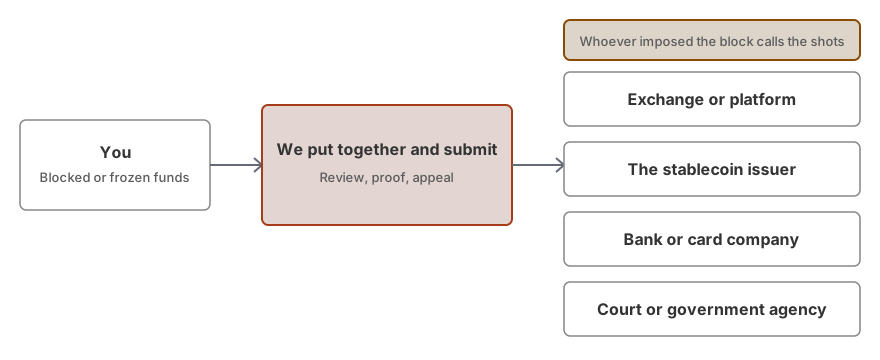
- No-cost review
Tell us who asked for what and why. We reply in writing on whether a report would help and what it would need.
- Scope in writing, with fee
Before you pay anything, you get the question, the addresses in scope, the specialists involved and how the fee works.
- Following the money
Independent specialists follow the transfers and tag the counterparties involved. Before anything goes further, we check the draft for holes and for claims the data does not actually back up.
- Reconciliation Check
Your own records get checked against the on-chain history. If something does not line up, we ask you about it first, before the report is finalised.
- Handover and use
You get the finished report plus a brief guide on presenting it. We can also help you pass it to the platform or to counsel.
What you should have ready
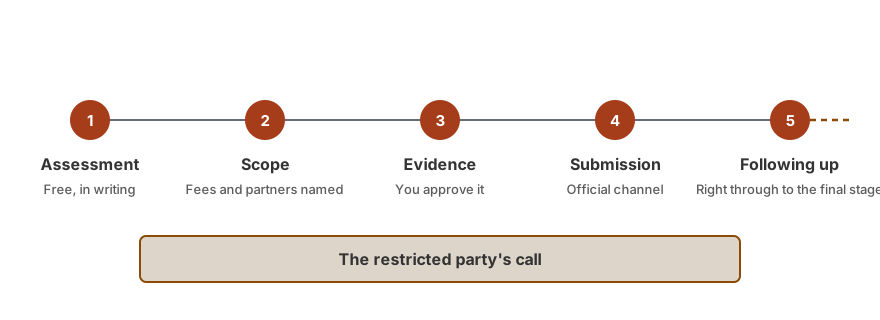
- Which wallet addresses are in scope, and which ones are yours
- Transaction hashes, or the dates and amounts of the transfers that matter to you
- The precise question or request coming from the platform, bank or lawyer
- Exchange exports and your trade history covering the period in question
- Receipts or bank statements that show when you first bought the funds
- Any risk score, screening result or report that was handed to you before
Time estimates
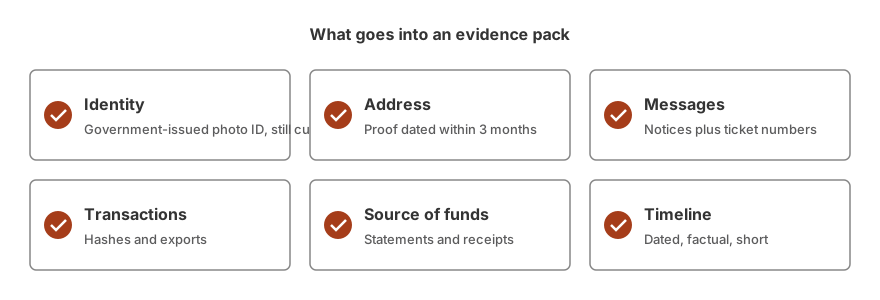
Timing depends on how many addresses are involved, how deep the trace must go, and how quickly you can provide matching records. You get an estimate after the assessment.
Cost Breakdown
The assessment costs nothing. Report fees depend on scope and complexity, and you get a written quote before paying. No fee is requested before we tell you whether a report would help. Cost Breakdown →
Real questions
What is included in a source-of-funds report built on blockchain analysis?
You get a summary first. Then the path of your funds, traced from the earliest source we can identify to your address, plus a table of transfers and the counterparties, labelled. Risk flags come with explanations. There is also a note on method and limits. It is written for a compliance reader, not a technical one.
Can a blockchain report show that my funds are legitimate?
This report does not confirm legitimacy automatically. It simply tracks where the money moved and what details the involved parties carry. The real question of legitimacy relies on how you originally earned or paid for those funds. We include your bank statements and purchase receipts to check that history alongside the technical data.
Will an exchange take this report?
Some compliance teams find it useful. Others run their own tools and treat it only as context. We cannot promise acceptance. What usually helps more than raw transaction lists is a clear report paired with matching documents.
Do you need access to my wallet?
No. Tracing only uses public addresses and transaction hashes. Never share a seed phrase, private key or password with anyone selling a report. A real analyst has no need for them.
What happens if the trace passes through a mixer or a bridge?
The report flags the spot where the trail fades and tells you what is clear on both sides. Certain bridges let you trace further. Mixers mostly do not. We show you the hard limit instead of making a guess.
Is this the same thing as a risk score?
A risk score is merely a number from a screening tool. The report clarifies the transfers that led to that assessment. You can use these real details to challenge any score that doesn't match your actual transaction history.
Related situations
- Who froze my crypto? A freeze diagnosis. Name who froze your funds, then see what can realistically be done.
- Proof of funds and wealth origin packs. Prepare a clean source of funds and source of wealth pack that exchanges, banks and processors will accept.
- Wallet screening flags and risk disputes. Flagged high risk by screening tools: document the funds path and dispute it.
- Tracing stolen crypto, sending freeze requests. Trace stolen crypto, request freezes at exchanges and issuers, file a police report.
Read next
Everything on this page is general information. It is not legal advice.