Your wallet or deposit got a high-risk flag: how to document the facts and push back
Published: Last reviewed: How we edit
Screening tools rate wallets based on ties to risky services: mixers, darknet markets, sanctioned entities. A high score can freeze your deposit even if you did nothing wrong, because the risky link might sit several hops away. Flags can also be wrong or simply stale. Here is what we do: trace how your funds actually moved, document that path, and dispute the flag with the exchange. We will not help hide illicit funds.
Got a question about your case? Ask us here:
The hard facts about our limits
- Nobody can force an exchange or screening vendor to clear a flag. They answer to their own rules and to the law that binds them.
- Here is the hard part: we do not hide, clean or mix illicit funds, and we turn away cases where the money looks like it comes from crime.
- When the analysis confirms the flag is right, we tell you straight, and we do not promise any result.
- We never ask for seed phrases, private keys, or exchange passwords.
You should use this service if
- An exchange cited a high risk score and rejected or held your deposit
- Someone paid you in crypto, or a store did, and afterward you learned the coins had passed near a mixer or darknet source
- A free checking tool shows a risk label on your own wallet and you cannot tell why
- A compliance team questioned a counterparty you barely know
Common issues
- Deposit shows up, then gets held once an address screening alert fires
- Funds received from a peer-to-peer trade whose sender wallet touched a mixer years ago
- Wallet tagged for sanctioned exposure after a small transfer you never asked for
- Exchange will not name the exact cause beyond a high risk score
- Withdrawal denied because an earlier deposit traced back to a flagged cluster
- Business wallet flagged because a customer paid from a risky address
How we help
- Know what the flag really says
We retrieve the exchange's exposure category and the specific screening vendor. We then analyze how high scores function in those tools. Direct connections to risky services carry far more weight than indirect exposure across multiple hops.
- Trace where your funds really came from and went
Analysts working independently trace the path of your funds, going backward to where the transactions began and forward to the entity that raised the flag. What you get back is a clear picture: whether the exposure touched you directly or through an intermediary, whether the amount was minor, or whether it had nothing to do with your own activity at all.
- Write down your side in plain words
First, we help you put in writing how the funds came to you, from whom, and for what reason. Then we attach purchase records, chat logs and receipts. A dated, consistent story is the only thing a compliance reviewer can truly check.
- Dispute the flag with the exchange
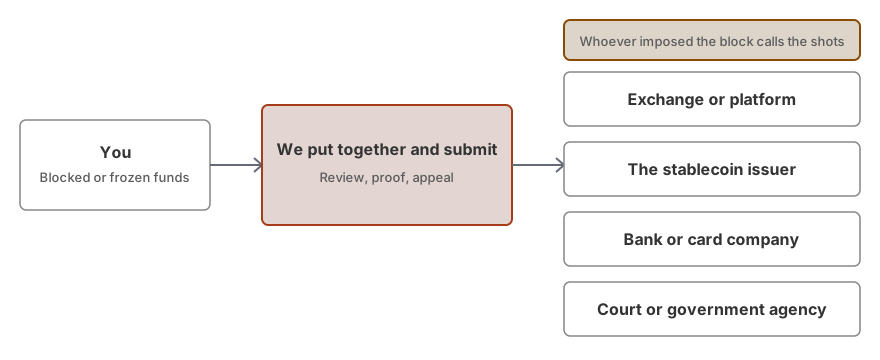
Next, we draft a structured dispute. It names the transactions in question, explains why the exposure is indirect or simply mistaken, and requests a specific review. The tone stays factual, and it goes through the exchange's official channel only.
- Dispute the flag with the analytics vendor
Sometimes the data itself is the problem: an outdated label, or coins assigned to the wrong cluster. In that case we help you file a correction request with the screening vendor, usually through the exchange or the vendor's own dispute form.
The steps in this process
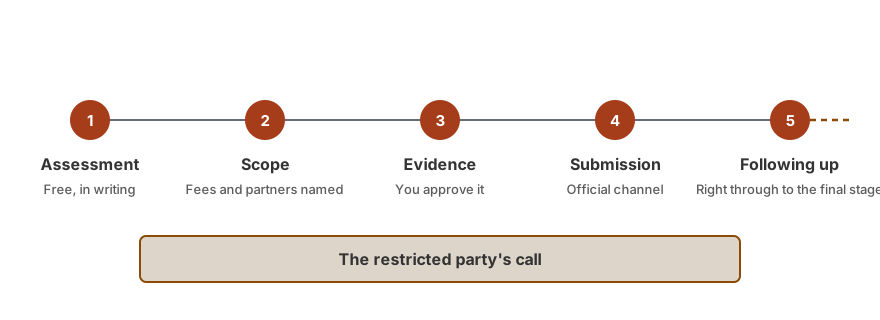
- No-cost evaluation
Start by telling us what got flagged and forwarding the notice. We answer in writing with an honest read: false positive, indirect exposure, or something harder. We also say plainly whether we can help.
- Scope and fees, in writing
Here is the hard part: you see a written scope, the names of the independent analysts, and the fee structure before you pay anything. You pay zero until you have read and agreed to it.
- Reviewing Your Transactions
Independent analysts go through the flagged transactions and trace the path of the funds. What comes back to you is a plain-language summary: what the blockchain shows, and what it does not.
- Filing your dispute
We submit the dispute pack, with the evidence attached, to the exchange. Where a vendor is involved, we also send a correction request. You receive copies of everything, plus the reference numbers.
- Follow-up and what comes next
We monitor the replies, handle any follow-up questions, and give you an honest read: either the flag holds up, or there is no route left. That truth comes early, not at the end.
What you should have ready
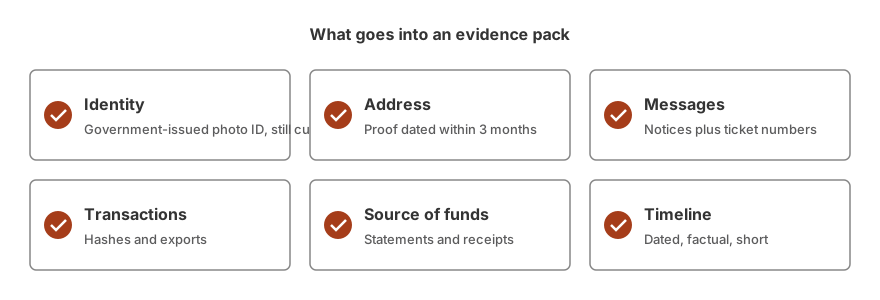
- The exchange email or notice that flags your account
- Transaction hashes and the wallet addresses involved
- Proof of where the funds came from: receipts, invoices, chat logs or bank transfers
- Who the counterparty is, if you know, plus any contract or order
- Screenshots from any third-party risk checker you used
- Photo ID plus something that shows your address, when the exchange requests these
- A brief written record of the transfer and the first alert
Time estimates
How long a review or dispute takes depends on the exchange's compliance queue and on how many transactions have to be traced. A short case with one path moves faster. You get an estimate once the assessment is done, and we update it as replies come in.
Cost Breakdown
The assessment costs nothing. After it, you get a written scope and a fee model for your case. We do not ask for any fee before we have told you whether we can help. Cost Breakdown →
Real questions
What does a high-risk wallet flag mean?
It means a screening tool has linked the address to a category like a mixer, a darknet market or a sanctioned entity. That link may be direct, or it may sit several hops away. Treat it as a signal for review, not as proof that you did anything wrong.
Can a flag be a false positive?
Yes. Labels can be stale, clusters can be attributed to the wrong owner, and small indirect exposure can push a score up. That is exactly why a transaction-level review is worth doing. There is no promise the tool or the exchange will agree, but we can lay out the facts clearly.
Can a wallet flag be taken off?
Short answer: no, not by us. The flag is owned by the vendor and the exchange, so we have no button to press. What we can do is build a file showing why the flag may be wrong, then send a structured correction or dispute through the channel that actually handles these cases.
Will you work with me if my funds really did come from a darknet market or a mixer?
No. We do not help anyone hide or launder illicit money. If the analysis shows a genuine link, we will say that to your face. Even then, you may still need to answer a lawful compliance request, and we can help you respond truthfully, with an independent lawyer involved if the situation calls for one.
What mistakes should I avoid once my deposit gets flagged?
Do not shuffle your funds through other wallets or services to slip past the review. That looks like evasion, and it makes your situation worse, not better. Leave the funds where they sit, keep every record, and answer the exchange's questions honestly.
Is a free risk checker enough on its own to show my wallet is clean?
No. Free tools run on different data and scoring than whatever your exchange relies on, so a clean result there cannot override their verdict. Where it does help: as one more piece of evidence in a dispute.
Related situations
- Help when sanctions or AML flags hit your funds. AML or sanctions match issues? Get the evidence and a lawyer-filed statement to remove the flag.
- Blockchain analytics report, explained plainly. Traced transaction evidence for a source-of-funds report, built for compliance review.
- Unblocking an exchange account. Decode the freeze, build KYC/AML evidence, answer compliance, file the appeal.
- Who froze my crypto? A freeze diagnosis. Name who froze your funds, then see what can realistically be done.
Read next
Everything on this page is general information. It is not legal advice.