Pig Butchering Scams: The Truth About How They Operate and Recovery Steps
Published: Last reviewed: How we edit
Nobody can promise to get your funds back. Pig butchering starts by building trust on social media. The scammer then pitches a crypto investment. You likely bought crypto on a real exchange and moved it to their address. Stop payments immediately. Do not trust anyone offering recovery services for a fee.
Got a question about your case? Ask us here:
The Hard Truth About This Scam
It is just a long con. The fraudster first develops a relationship. They then pivot the conversation toward a crypto investment opportunity, encouraging further payments.
According to the Canadian Anti-Fraud Centre, these scams usually begin on social platforms. Once trust is established, the scammer presents the idea of wealth through crypto. Victims often use a trusted exchange to buy assets, which they then send to the scammer's specific address.
Pay attention to the details. Seeing a known exchange on your bank statement can make you think the investment is legitimate. It only proves the crypto was purchased. When it leaves your account for the scammer, it is gone forever. Unlike card payments, crypto lacks standard fraud protections. If this sounds familiar, review the warning signs below.
The Timeline: How These Scams Progress
The story shifts, but most cases run along the same path. Check the table to place yourself. The right column tells you what to watch for at each step.
We invented the stage labels. The pattern itself comes from public alerts by consumer agencies and police, and no two cases are alike.
| Stage | What happens | What to notice |
|---|---|---|
| First contact | A stranger messages you on a dating app or social platform, friendly and full of questions. | Someone you have never met shows fast, warm interest, then pushes to continue on a private chat app. |
| Building trust | Messages come daily, with photos, plans you share together, and talk about a future. The person refuses to meet face to face or on a live video call. | You get close fast, and there is always an excuse for why a meeting never happens. |
| The investment pitch | They bring up a crypto opportunity, usually an app or website for trading that they claim a relative or they themselves use. | Someone new shows you how to earn with crypto and offers to walk you through it. |
| First deposit and fake gains | You buy crypto and transfer it to a platform or address they name. Profits appear to climb on screen. | That balance lives only on a page or app controlled by the scammer's side. |
| Bigger deposits | They push you to deposit more, sometimes drawn from a pension, a loan or savings. | They push you to act fast and to keep it quiet from your bank, family or friends. |
| Cashout refused | Your withdrawal does not go through, or a fee, tax or deposit is demanded first. | They want payment before you can touch your own money, and every payment is followed by a fresh excuse for one more. |
| Recovery offer | Once the money is gone, a stranger appears, promising to get it back for a fee. | A new stranger, a new fee. The Canadian Anti-Fraud Centre describes these pitches as another layer of the same scam. |
Warning signs to check today
Any single sign might have a harmless reason behind it. But when several show up together, that is your cue to pause, stop paying and confide in someone you trust. Two or more signs below fit your situation? Skip ahead to the next section right away.
- You crossed paths with this person online, have never met face to face, and money or crypto has already come up.
- You get pointed toward one specific trading app or site, and no independent information about it turns up anywhere.
- The platform displays big profits fast. Money goes in easily. Getting it out is another story.
- Before you can touch your own balance, you must pay a fee, a tax or another deposit first.
- They want crypto sent to an address they hand you, or they claim to be collecting for a government body. The Canadian Anti-Fraud Centre flags any demand for crypto in a government's name as a scam signal.
- They steer you away from talking to your bank, your family or a financial adviser.
- They pressure you to hurry, or to borrow money so you can put in more.
If this is happening to you right now
This has happened to plenty of people before you, and the blame sits with whoever deceived you. Skilled scammers fool careful people every single day. What helps right now is a short list of calm actions.
Reporting fast can make a difference. The Canadian Anti-Fraud Centre describes a 2022 case in Winnipeg where 17,000 dollars was clawed back after reports went to both the centre and the police. That is not the usual result, and nobody can promise one. It still shows why reporting quickly is worth doing.
- Stop every payment: fees, taxes, so-called 'verification' deposits, all of it. Never send a test amount just to see if withdrawals work.
- Do not threaten the scammer or argue with them. First save all your messages, then stop answering.
- Keep the evidence together: wallet addresses, transaction hashes, screenshots of the chats, profiles and the platform, plus your bank and exchange records.
- Phone your bank and the exchange you used and explain what happened. They can act only on money or payments still under their control.
- File a report with the police or the national fraud service. Our reporting-by-country guide lists official channels in eight countries.
- Lock your accounts down: change passwords and uninstall any app or remote access tool the scammer talked you into installing.
- Tell a person you trust. Shame keeps many victims quiet, and that quiet is exactly what scammers want.
How recovery scammers hunt victims later
One scam can lead straight into another. If you lost money once, someone may contact you soon after, sometimes within days, offering to get it back.
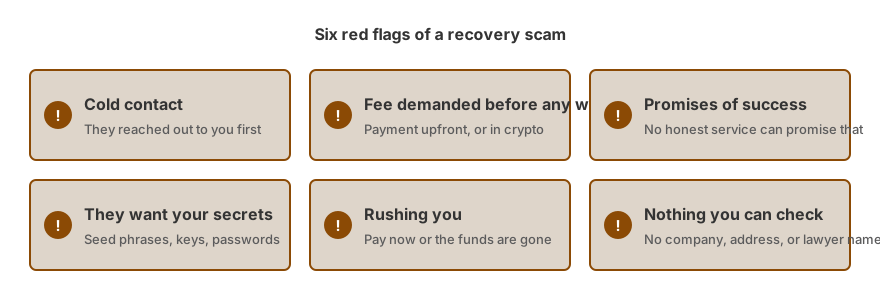
The FBI's IC3 has flagged fake law firms that tell you a government list proves you were scammed and legal help can get your cash back. The Canadian Anti-Fraud Centre calls any recovery offer that asks for a fee just more of the same con. Kraken says practically every promise to recover missing crypto is another trap, often one that demands money up front.
Here is a plain rule from the US Federal Trade Commission: never pay anyone who contacts you out of the blue and says they can recover money a scam took from you. IC3 makes the same point. Real law enforcement does not bill victims.
Do not rely on contact details the lawyer or firm sends you. Look them up in the official register yourself. Never let anyone take remote control of your device, and never give out a seed phrase, private key or password. The recovery scam check tool on this site asks ten questions and flags the warning signs.
Where to get help next
Want help sorting evidence, following the money, or filing freeze requests with platforms that can act? Ask us for a free assessment first. We answer in writing about whether we can assist, and no fees come up until that reply exists. Independent specialists handle the tracing and legal work; our job is coordination. Exchanges, issuers and the police decide on their own whether they act. That is their call, not ours. And we will never ask for your seed phrase, private key or password.
Unsure whether a scam is happening to you? Send us the details for a calm second opinion before any money changes hands.
Frequently Asked Questions
Why is it called pig butchering?
It is slang for fattening up a victim's trust before taking the money. Agencies use the term too, often alongside the plainer phrase romance-investment scam. Same pattern, two names.
If a romance investment scam took my money, can it be recovered?
Sometimes. Not often. Nobody can promise it. If the money landed on an exchange that can freeze it, a fast and well-documented report may help. If it sits in a private wallet, there may be nothing to freeze. Even so, reports build records that banks and authorities use.
They want a fee or tax paid before my withdrawal goes through. Is that legit?
Here is a red flag. A platform demanding fresh money before releasing your own balance may be showing you a balance that never existed. Do not pay. Keep the message, stop sending funds and report the platform.
Was being fooled your fault?
No. These schemes are built to earn trust bit by bit, and they fool smart, careful people too. Many victims keep quiet because they feel ashamed, and that silence is exactly what the scammers want. Talk to someone you trust, then follow the practical steps in this guide.
Someone says they can get my crypto back if I pay upfront. What now?
Check them before any money changes hands. A recovery offer you never asked for is a classic second scam. Get the company name and registration number, then confirm both on your own. Report the contact to the platform it came through. Never share a seed phrase, private key or password.
How we can help
- Help after a crypto scam. Steady help after a crypto scam: assess, document, trace, send freeze requests.
- Tracing stolen crypto, sending freeze requests. Trace stolen crypto, request freezes at exchanges and issuers, file a police report.
- Preparing digital evidence for crypto cases. Capture, log and sort chats, screenshots and records so police, exchanges or lawyers can work with them.
- Blockchain analytics report, explained plainly. Traced transaction evidence for a source-of-funds report, built for compliance review.
Sources
These come from official or authoritative pages. Since pages can change, verify the current wording at the source.
- Investment scams and fraud · Canadian Anti-Fraud Centre
- Crime information: Cryptocurrency · FBI Internet Crime Complaint Center (IC3)
- Worried about crypto exchange losses? Don't pay money for help recovering money · US Federal Trade Commission
- Can I recover crypto lost to a scam? · Kraken
Everything on this page is general information. It is not legal advice.