
P2P trade left you frozen out? Bank blocks, exchange holds, and how to document your deal
Published: Last reviewed: How we edit
Nobody can promise to unfreeze your money. Here is what happens: a P2P trade gets flagged when the other side is reported for fraud, or when the bank or exchange ties your payment to a risky account. You may have done nothing wrong and still be stuck. The way out is proof that the trade was real: chat logs, receipts, payment records and your own history. We help you build that case and prepare the appeals.
Got a question about your case? Ask us here:
The hard facts about our limits
- Banks, exchanges and the police answer to their own rules and applicable law. We cannot make them release anything.
- The truth is we cannot promise a final result or a set timeline. A frozen payment from a fraud case may remain held for a long time.
- We won't help you create fake evidence or hide facts about fraud.
- Your seed phrase, private keys and passwords stay yours. We do not request them, ever.
You should use this service if
- Your bank account is frozen because money from a P2P crypto buyer landed in it
- Your exchange account is restricted because a P2P seller you bought from got reported later
- A bank or a police officer told you the incoming payment is tied to a fraud complaint
- You sold crypto honestly, and now the buyer's bank wants the payment reversed
- You have no idea how to show the trade was real and the payment was fair
Common issues
- Bank freeze on the account that got a P2P payment
- Your crypto is frozen because an exchange flagged coins bought from someone accused of fraud
- A bank chargeback or recall filed by the other side's bank once the trade had already closed
- Counterparty says the payment was an error or made under pressure
- Lots of small P2P trades in a short window flagged as unusual activity
- Funds held up during a police inquiry into the other side's account
How we help
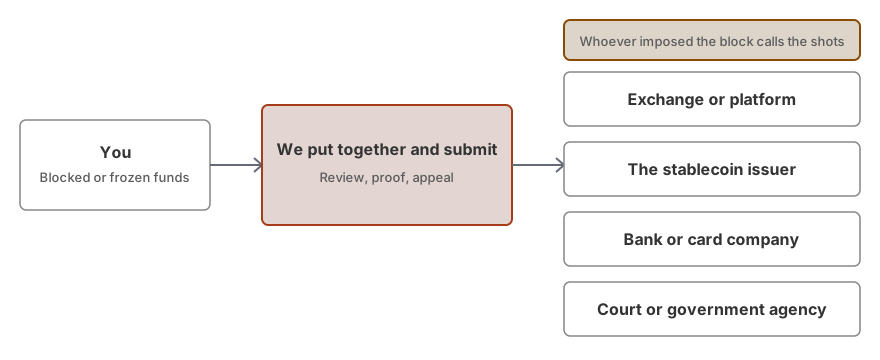
- Work out who holds the funds and on what grounds
Banks, exchanges and police each have their own rules and their own way out. We go through the notices and work out which party holds the money, and what kind of request sits behind it.
- Rebuild the trade
We sort the P2P deal into order: the advert, the chat, the agreed price, the payment confirmation and the coin release. A dated sequence is the strongest proof the trade actually happened.
- Prove you acted honestly
We help you gather proof of normal trading: prices at market rates, your identity checks, the platform's own records, and your past activity. One trade reads very differently inside a clean pattern.
- Write appeals to the bank and exchange
We draft a short, factual appeal for each party. It cites the reference, includes the evidence, and requests a clear outcome, like releasing the funds or confirming what they need.
- Bring in lawyers when needed
If the bank or authority stays silent, or the sum justifies legal steps, independent licensed lawyers can act. We build the file and keep the case coordinated.
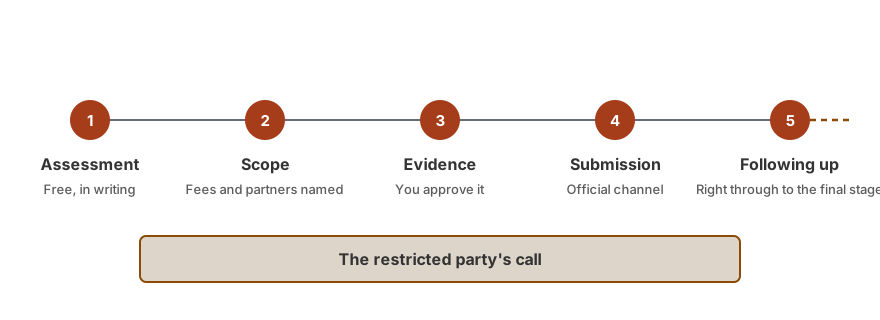
The steps in this process
- No-cost evaluation
You describe what got frozen, who froze it, and how the trade ran. We state in writing whether we can assist and which route looks likely.
- Scope in writing, with fee
Before you pay anything, you receive the full details first. This includes the project scope, the fee structure, and the names of the independent specialists assigned to handle your case.
- Evidence gathering
You send chats, receipts, bank statements, and platform records over a secure channel. We screen them for gaps and conflicts before anything goes out.
- Filing Appeals
Every appeal is filed through the bank's and the exchange's own official channels. You get copies of each filing, plus the reference numbers for your records.
- Following up
We keep an eye on the replies, help you answer any follow-up questions, and tell you the plain truth when the case has hit the limit of what can be done.
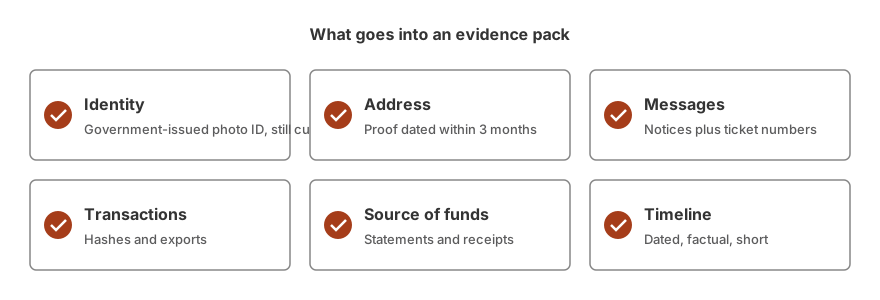
What you should have ready
- Government-issued photo ID plus proof of address
- Screenshots or an export of the P2P advert, plus the complete chat with the other party
- Payment proof from your bank or payment app, showing the date and the amount
- The order record from the P2P platform and the confirmation of release
- Your exchange history, showing which coins came in or went out
- The notice you got from the bank or exchange, including the reference number
- Your past P2P or trading history that proves you traded normally
- A brief written timeline laying out the trade step by step
Time estimates
Exchanges and banks can review this for weeks. Police investigations make it even longer. We provide an estimate after we assess the situation and keep you updated.
Cost Breakdown
The first check costs you nothing. After that, you get a written scope and a fee model matched to your case type. No fee comes before we tell you whether help is possible. Cost Breakdown →
Real questions
My P2P trade was standard. Why did my funds get frozen?
Banks and exchanges scan account activity related to your payment. If the other person is flagged for fraud, your money can get held too. You must then show that your transaction was completely legitimate.
What evidence proves your trade was legitimate?
To build a strong case, you need a clear timeline: the ad you saw, the full conversation, the agreed price, proof of payment, and when the coins were released. Also include the platform's order record and your own trade history. If chat logs are missing or edited, it weakens your position.
Can the opposing party's bank take back the funds?
Banks sometimes reverse payments if they claim mistake or fraud. You need the transaction evidence ready. If a large amount is reversed, you might need a lawyer.
Should you try moving your frozen crypto or funds to a different place?
No. Shifting money that is under review can look like you are hiding it, and that can make your case harder. Leave the account alone, respond to what you are asked, and keep every message you send or receive.
What separates a bank freeze from an exchange freeze?
A bank freeze locks your cash, often after a fraud claim, a court order, or the bank's internal risk check. An exchange freeze locks your crypto, usually due to a compliance review. Each type has a separate path to appeal, and sometimes you face both.
Should you hire a lawyer?
Usually not right away. If the bank or agency brushes off your appeal, if someone files a recall claim against you, or if the sum is big, a lawyer starts to matter. Independent licensed lawyers do the legal work, and we let you know once it reaches that point.
Related situations
- Unblocking an exchange account. Decode the freeze, build KYC/AML evidence, answer compliance, file the appeal.
- Proof of funds and wealth origin packs. Prepare a clean source of funds and source of wealth pack that exchanges, banks and processors will accept.
- When authorities freeze your crypto. Authorities hold your assets: we coordinate independent licensed lawyers. We give no legal advice.
- Blocked crypto cards and payment accounts. Crypto card, neobank, or processor account blocked? Find the cause. Gather documentation. File an appeal.
Read next
Sources
These come from official or authoritative pages. Since pages can change, verify the current wording at the source.
Everything on this page is general information. It is not legal advice.