
Appealing to a crypto exchange: structure, tone, and what to attach
Published: Last reviewed: How we edit
Keep the appeal short, factual and complete. Say who you are, and name the affected account. Describe the restriction, and include its date. Answer the question the exchange actually asked, and show by documents where your funds came from. Close with one clear request. Send it once, using the official channel. Save the reference number. Skip the anger, the threats and the guesses.
Got a question about your case? Ask us here:
Start by checking what the exchange is really asking
A message about a restriction doesn't always invite an appeal. Some notices ask for documents. Others simply tell you a decision has been made. Read the notice twice, work out which type you have, because each needs a different reply.
Does the notice ask a question? Then answer it, and nothing else. Does it report a decision you believe is wrong? Then write an appeal. If the platform provides its own form with fixed fields, complete that form. Use the structure below only in a free-text box.
Some exchanges state plainly that they will not disclose why an account was restricted. Kraken's help page says so outright. Do not guess at the reason. Ask instead which information would let the review move forward. First, copy the request word for word into your notes.
A skeleton you can adapt to your own case
Keep the same order every single time. A reviewer goes through many files, and a familiar structure lets them locate your facts, your documents and your ask within seconds. The skeleton below is generic. Swap each description for your own facts, and leave out anything you cannot support.
At /tools/appeal-letter/ there is a free appeal letter builder. Type in your facts and it puts them into this order. It runs in your browser, keeps nothing, and never adds material you did not enter. Copy the letter, download it as text, or follow the skeleton yourself.
| Section | What to write |
|---|---|
| Subject line | Say what the letter is for and include your case reference if one exists, for example: request for review of an account restriction. |
| Who you are | The name on your account exactly as the platform has it, plus the email or account ID the platform uses, if it has one. |
| The restriction | Which actions are blocked (login, withdrawals, trading or the entire account) and the date it started. |
| What you were told | What the exchange told you, put in your own words. Include the date and any reference number they gave. Quote the text only when you can reproduce it word for word. |
| Where the funds came from | The source in plain facts, like salary, sale of an asset or earlier trading, plus the names of the documents that prove it. |
| Documents attached | Each file by name, plus the question it answers. |
| What you ask for | Make a single, specific ask, like: take another look at the restriction, or tell me exactly what information you still need and by what date. |
| Close | Ask for a case number and the next step, give your name, and use a contact method the platform already has on file. |
Tone: calm, short and specific
Picture a busy reviewer with your file open and nothing else. That is who you write for. Short sentences help. So do dates and exact amounts. State the account, the dates, and the documents you attach. Skip the adjectives entirely.
Keep the first letter neutral. Rants about the exchange, threats to sue, and talk about your feelings do not move the reviewer, and they bury the facts that matter. If you escalate later, you will hold a clean record showing you answered in full. Then read the draft once and delete any sentence that is not a fact or a request.
- Make one request per letter. One clear ask is easier for a reviewer to act on than a list of demands.
- Write in everyday language, matching whatever tongue the support team speaks.
- Spell out dates in full, like 12 October 2026, and always pair amounts with their currency.
- Lead with facts, then make your request. Leave your opinions about the decision out.
- Do not guess at why the exchange acted, and leave its staff out of the letter.
- Stay polite, even when you are frustrated. A courteous letter is easier for someone to act on.
What to include
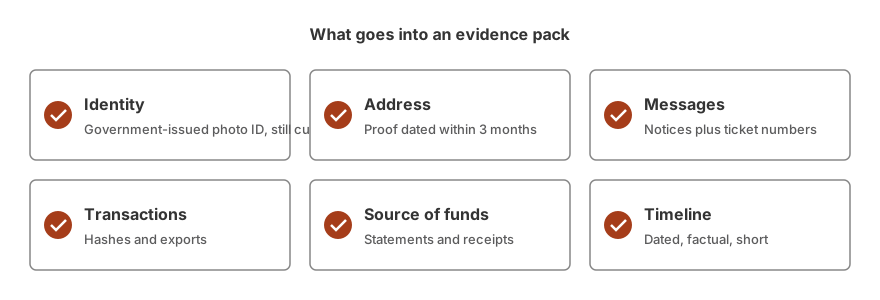
Only attach files that answer the question being asked. Every document has to earn its spot, and your letter should explain what each one proves. Kraken's help page, for example, asks customers to send clear, current documents and respond to all questions at once, since partial replies can cost extra days. Gather everything before you write a word.
- Government-issued photo ID in the name on the account, plus proof of address if the notice requests it.
- The message the exchange sent you, or a screenshot of the block that clearly shows when it took effect.
- Statements or receipts from your bank tracing funds you sent to the exchange, or payouts the exchange returned to you.
- Exported records of your past trades on the exchange, if that is where the money came from.
- The wallet addresses you own, plus a short note on how you would demonstrate ownership if asked.
- A timeline on one page, running from your first deposit up to the date the account was frozen.
- A brief cover note naming every attached file and the question each one addresses.
What to skip
Keep out anything that adds risk or noise. Extra private details do not make a case stronger, and some can sink it. Before sending, run the draft through this list once, then check it against the notice.
- Seed phrases, private keys, passwords and one-time codes. Never include these in an appeal, and never share them with anyone who offers help.
- Documents you edited, retouched or cannot verify. Explaining a missing paper is far easier than explaining a changed one.
- Off-topic gripes, long personal stories and old feuds.
- Personal data belonging to other people, unless the request truly requires it and they have agreed.
- Claims about laws or rights you have not verified. One wrong legal assertion can weaken an otherwise solid letter.
After you send it
Submit the appeal one time only, through the official channel the notice names. Keep a copy of exactly what you sent, the date, and any reference number you get back. Never route it through a third party who contacted you first, and never pay someone to deliver it.
After that, wait out the stated review window. Our guide on how long an exchange compliance review takes covers what two exchanges say about timing. Once the window passes, send one follow-up in the same thread. A no? Ask them to name the exact reason, and check if the platform allows a second review.
If your documents keep getting rejected, a large amount is at stake, or a regulator may eventually hear a complaint, extra help can pay off. The first assessment with us is free, and we state in writing whether we can help before any fee comes up. We cannot force the exchange to rule in your favour, and we never ask for a seed phrase, private key or password. For a second pair of eyes on your draft, request the assessment.
Frequently Asked Questions
Should you send one long message or a few short ones?
Send one complete letter. A single message with all documents attached hands the reviewer your full case in one pass. Splitting it into partial messages scatters the facts and can leave the reviewer unsure which version is current.
Is it okay to use a template or an AI tool for my appeal?
Templates are fine for the shape of a letter. The facts inside it still have to come from you, and each one needs a document behind it. Check that no tool invents dates, amounts or reasons you never supplied. And never type a seed phrase, private key or password into any tool.
What happens if my appeal is turned down?
Ask which specific reason applies and what information is missing. Check whether the platform allows a second review. Match the answer against your documents and close any gap. Where such a route exists on a regulated platform, a complaint to the regulator or ombudsman may be possible.
Should the first appeal name a lawyer or a regulator?
Only if you have actually hired one. Your first appeal should state the facts plainly and ask for something specific. Dropping a lawyer or regulator name you never contacted looks like a threat, and it proves nothing.
Do I need to pay anyone to write the appeal?
Not required. Plenty of customers handle the appeal on their own. Where paid help earns its fee is a messy set of facts or a big sum. Get the scope and the price in writing first, and see any unsolicited offer that lands in your inbox as a red flag.
How we can help
- Unblocking an exchange account. Decode the freeze, build KYC/AML evidence, answer compliance, file the appeal.
- Proof of funds and wealth origin packs. Prepare a clean source of funds and source of wealth pack that exchanges, banks and processors will accept.
- Who froze my crypto? A freeze diagnosis. Name who froze your funds, then see what can realistically be done.
- Filing complaints with regulators and ombudsmen. Build a structured complaint for a regulator, ombudsman or consumer body, with a clear chronology.
Sources
These come from official or authoritative pages. Since pages can change, verify the current wording at the source.
- Why is my account restricted? · Kraken
Everything on this page is general information. It is not legal advice.