Why your withdrawal is stuck, and what the travel rule means for you
Published: Last reviewed: How we edit
Nobody can promise your withdrawal clears fast. Platforms hold transfers for a few reasons: a recent security change, a deposit still settling, a risk flag on you or the receiving address, missing identity details, or a compliance review. The travel rule answers many questions about the recipient. It requires crypto businesses to exchange sender and recipient details when funds move between them. Before you withdraw, have the recipient's name, platform and wallet type ready.
Got a question about your case? Ask us here:
A hold means pause, not guilt
A withdrawal hold is when the platform pauses one transfer, or your entire account, until it receives what it asked for. Most holds trace back to automated rules and a brief review. On its own, a hold is not an accusation.
A short message can hide a lot. 'Under review' or 'pending' might mean a security delay, or it might mean a compliance check. Those lead to very different next steps. So the first job is to work out which category you are likely in. The table below covers the common ones.
| Reason | What you might run into | What often fixes it |
|---|---|---|
| Recent change to password, device or two-factor login | The platform freezes withdrawals for a fixed period after that change | Wait the length the platform names. Do not touch several settings in one go. |
| A card or bank deposit you made recently | The balance appears on screen but you cannot pull it out yet | Look up the settlement period on the platform's help page, then withdraw once it passes. |
| A withdrawal that is large or out of the ordinary | A notice about manual review, or a request for extra information | Answer a single time, give the full reply, and state the purpose in plain words. |
| A verification tier on your account set too low | A limit notice, or a request to confirm who you are | Complete the identity check using clear, up-to-date documents. |
| A destination address that got flagged for risk | A withdrawal that fails or hangs, sometimes with a risk warning | Ask what the flag stands for. Do not hop to other addresses to dodge it. |
| Travel rule details not supplied | A request for the receiver's name, platform or wallet kind | Fill in the form exactly as asked, with true details. |
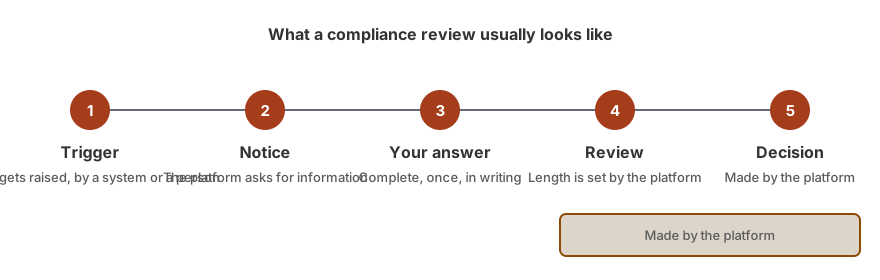
| A compliance check on the account | A freeze across the whole account, plus a request to show where the funds came from | Give a direct answer to what was asked. Our guide on why exchanges freeze accounts covers the usual triggers. |
| Heavy network traffic or scheduled maintenance | A banner on the platform's status, or a transaction still waiting on confirmations | Look at the platform's status page, then trace the transaction on a block explorer. |
The travel rule, plainly explained
When a payment moves between two banks, information about the sender and the receiver goes along with it. The travel rule brings that same idea to crypto. When one crypto business sends funds to another, it passes on certain details about who is sending and who is receiving. The business on the receiving end takes those details and checks them.
This idea comes from international anti-money-laundering standards, and many countries have written them into their own rules. The details vary. Some jurisdictions apply the rule to every transfer, while others only apply it above a set value. Some handle transfers to private wallets differently from transfers between businesses.
This regulation centers on sharing information, not on granting access. You will never need to supply your seed phrase, private keys, or passwords.
- Who sent it: the name, plus the wallet or account the money leaves from.
- Who receives, and the wallet or account where the funds land.
- Some places want one more detail about the sender, like an address, date of birth or ID number.
- The name of the business getting the funds, if a business is involved.
Questions a platform might raise about the recipient wallet
Adding a withdrawal address may trigger a question: whose wallet is on the receiving end? Your answer determines which checks run. Be honest here. A false answer can get the transfer rejected or stretch the review out much longer.
| What could be asked | Why platforms ask | Ways to be ready |
|---|---|---|
| Whether the wallet belongs to you or to another person | The rules and checks are not the same when you send funds to yourself compared to paying someone else | Make your choice first. If someone else is involved, keep their information at hand. |
| If the wallet lives on another exchange or is one you control yourself | The platform might have to swap information with the other company, or verify that a private wallet really belongs to you | Look at the account you are sending to and note the platform shown there. If it is your own wallet, be clear on which app or device stores it. |
| The recipient's full name | To match it against the account holder name on the other side | Get the recipient to copy the needed text from their verified profile. You have to match the spelling exactly. |
| The receiving platform's name and country | So the data reaches the right party and local rules get applied | You will find it on the recipient's deposit page or in their account details. |
| Why the transfer is being made | To assess risk and document the reason the funds moved | Write one plain sentence. Add an invoice or contract if this is a payment. |
| Evidence that a private wallet is actually yours | To exclude the possibility that another person is behind the address | Pick a method the platform accepts, like a signed message or a small test transfer. Never share keys. |
Getting ready before you withdraw
A hold often catches you off guard, but some simple prep prevents a lot of it. Before you make a big withdrawal, or your first one, work through these steps. Waiting until the funds are stuck is too late.
- Finish all identity checks the platform requires. Your profile must accurately match your official ID.
- Name and label your withdrawal address ahead of time. Ensure you declare the correct wallet type.
- Don't change your password or device right before a major withdrawal.
- Test the connection with a small amount first. Wait for that initial transfer to successfully complete.
- Wait for your bank or card payments to fully settle. Only then should you pull the crypto linked to those funds.
- Save evidence of how you financed the account. This includes purchase receipts and bank statements.
- Never break a big transfer into many tiny amounts. This looks like an attempt to conceal funds. It will lengthen the review process.
What to do if the hold doesn't clear
Write to the platform and ask three things: which hold category applies, what info they need, and the typical duration of the review. Respond to everything in one message using their designated channel. Keep that ticket number secure.
Never try to move funds to outside addresses or accounts to bypass the hold. This creates extra activity requiring explanation. If responses are unclear, or they go silent past the quoted time, a formal escalation may help.
We can go through the hold notice with you, flag which type it most likely is, help you collect what they want, and write the response or the escalation with you. No platform has to release funds because we ask, and we will never request your seed phrase, private keys or passwords. The first look costs nothing. We only discuss fees after telling you whether we can help at all.
Frequently Asked Questions
How long does a withdrawal hold usually stay in place?
There is no single answer; the reason decides. If it is a security delay, the platform will often name a fixed period. A compliance check can take more time, and it typically clears once you hand over what was asked. Get the platform to state its timeframe, and keep that reply on record.
Under the travel rule, can the exchange look inside my private wallet?
No. The rule covers identity and account details, things like names and wallet identifiers. An exchange can see public chain data, same as anyone, but your keys and the wallet itself stay out of its reach.
Why did the exchange question a transfer I made to my own wallet?
Some platforms treat self-transfers differently from transfers to other people, so they ask whether the address is really yours. They may also run the address through risk screening. Tell the truth, and give proof of control that exposes nothing sensitive.
Can a private wallet let me sidestep the travel rule?
In most jurisdictions you are allowed to keep coins in a wallet you control yourself. The platform can still ask you to show the address is yours and can add extra checks. Moving funds through extra addresses to evade the rule tends to stretch any review out.
Does splitting a big withdrawal into several small ones help?
No. Breaking one transfer into pieces to slip under a limit or a check can look like you are hiding activity, and that can stretch out the review. Send it in one go, with the details the platform asks for.
How we can help
- Who froze my crypto? A freeze diagnosis. Name who froze your funds, then see what can realistically be done.
- Unblocking an exchange account. Decode the freeze, build KYC/AML evidence, answer compliance, file the appeal.
- Wallet screening flags and risk disputes. Flagged high risk by screening tools: document the funds path and dispute it.
- Proof of funds and wealth origin packs. Prepare a clean source of funds and source of wealth pack that exchanges, banks and processors will accept.
Everything on this page is general information. It is not legal advice.