
Transaction monitoring for crypto firms: scenarios, thresholds and alert handling
Published: Last reviewed: How we edit
Transaction monitoring checks customer transactions for signs of money laundering, fraud, or sanctions issues. Each alert gets reviewed and recorded. For crypto firms, this covers on-chain activity plus bank and card payments. We connect you with independent specialists who help build scenarios, set thresholds, pick tools, and draft alert workflows. Your compliance officer handles final decisions on alerts and reports. No system catches everything.
Got a question about your case? Ask us here:
The hard facts about our limits
- No monitoring set-up catches every suspicious case. We design around your risks, and we cannot promise a scenario will flag a specific pattern.
- Your compliance officer makes every alert call and any report to an authority. We do not touch live alerts, make those calls or file for you.
- We do not give legal advice, and we are not auditors or licensed officers. No supervisor or bank has to accept your system, and we cannot guess their view in advance.
- Tool advice follows what you need. Buying and signing are your call, and until a tool has been tested on your data we cannot promise it will work.
- Monitoring design runs on data and procedures. We never ask for seed phrases, private keys or passwords, and we never handle customer funds.
You should use this service if
- An exchange, broker, wallet or payment firm that started operating without formal monitoring in place
- A compliance officer drowning in alerts that are mostly false positives, with no clear way to document decisions
- A product team launching staking, cards or cross-border transfers that shift how activity looks
- A team comparing monitoring tools that wants a written list of requirements first
- Founders who have to show a bank or auditor how suspicious activity gets caught and handled
Common issues
- No written rules exist that say what must trigger an alert. Staff make calls case by case
- Your monitoring tool runs on defaults, and nobody has checked if those thresholds fit your customers
- The team gets more alerts than it can handle, so most get closed with a one-line note
- Wallets with indirect exposure set off flags, and the firm has no agreed method for handling them
- An auditor or bank has already pointed out gaps in how alerts get reviewed and documented
- You have to connect on-chain screening with customer risk ratings and travel rule data
- Your scenarios stop fitting when a new product or market arrives
How we help
- Map your activity and the real risks
Here is how we start: we look at how money and crypto actually move through your business. Deposit and withdrawal routes, customer types, countries, products, typical amounts. That picture shows which patterns genuinely warrant an alert, and which ones would just bury your team in noise.
- Design scenarios and set thresholds
Independent specialists build your monitoring scenarios: money moving out soon after onboarding, lots of transfers just under a limit, mixer exposure or links to high-risk countries. Each scenario comes with starting thresholds and the reasons behind them. Before go-live, those thresholds get tested against your own transaction history.
- Choose and configure your tools
You get help writing requirements for on-chain analytics, screening and case management tools. We compare options and plan a trial. We also check the data the tool needs actually reaches it. That data includes wallet addresses and travel rule fields.
- Put the alert procedure in writing
A clear procedure covers who reviews each alert, what evidence gets checked, how long a review can take, where decisions are recorded and when a case escalates to the compliance officer. Careful notes protect your staff and show a supervisor how each decision was made.
- Keep tuning as things change
Once you are live, the specialists go through alert results with you, examine false alerts and missed patterns and suggest adjustments. Every adjustment is logged with a date and a reason, so you can demonstrate how the system developed.
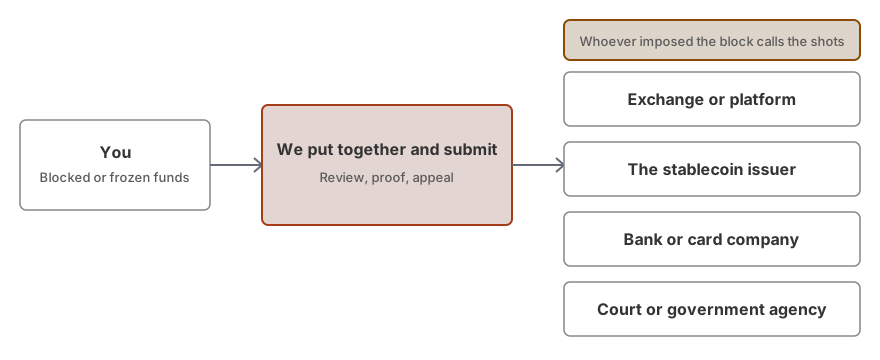
The steps in this process
- No-cost evaluation
Describe what your business does and how monitoring runs today. We state in writing whether independent specialists can assist and which data they would need from you.
- Scope in writing, with fee
Before any payment, you get the scope, the named specialists, the deliverables and the fee model in writing. Phases are priced one by one, so you can stop after any of them.
- Discovery and data check
Independent specialists go through your transaction flows, your written policies and a sample of older alerts. Then they spell out where your data falls short and which scenarios are actually worth building.
- Build and test the scenarios
The specialists write the scenarios, thresholds and procedures themselves, then run them against your own transaction history. We sit down with your team, go over the results and make adjustments.
- Handover and a review date
You get the finished documents, a training session for your staff, and a fixed date for the first review of alert results after launch.
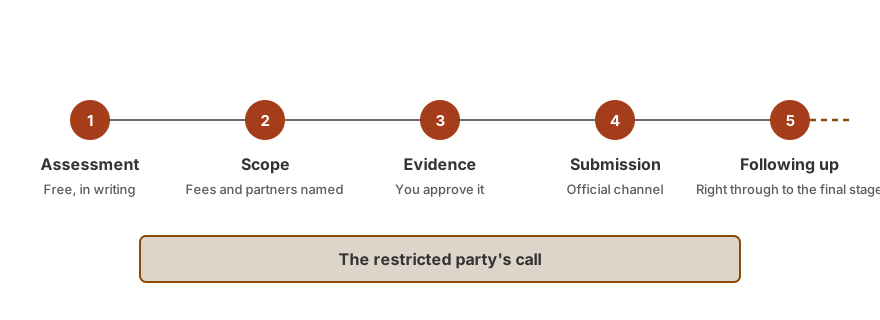
What you should have ready
- A rundown of what you sell, who your customers are, where they live, and usual transaction sizes
- The monitoring rules, thresholds and tool settings you use today, if any exist
- A sample of recent alerts with how each one was closed, personal data stripped out
- Alert statistics: monthly volumes, the share closed with no action taken, and how long closures take
- Your AML policy and the method you use to rate customer risk
- Any monitoring, screening or analytics vendor you already run, or one you are only looking at
- Findings or questions that a bank, auditor or regulator has raised about your monitoring
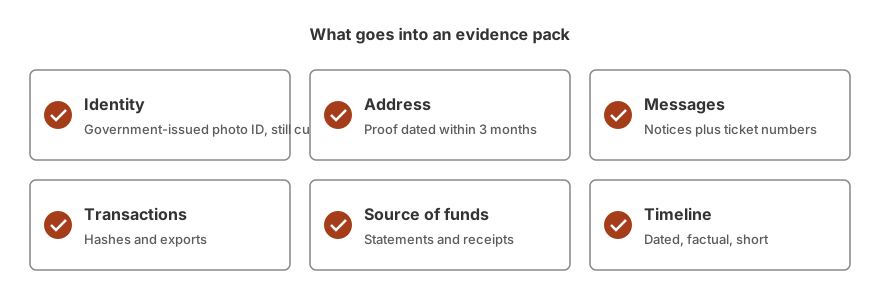
Time estimates
A first design for a small business can take weeks, and tuning keeps going after go-live, because real alerts reveal what the first thresholds missed. Phases and review dates are agreed in the written scope.
Cost Breakdown
The assessment costs nothing. After that we quote every phase in writing, with the independent specialists' fees listed separately, so you can stop whenever you want. No fee is taken before we tell you whether we can help. Cost Breakdown →
Real questions
What does transaction monitoring mean?
Ongoing review of what your customers actually do, meant to catch strange or suspicious patterns. Rules or models fire alerts. A person looks at each one, writes down the decision and passes it up when needed. In crypto, that covers on-chain transfers plus bank and card payments.
Can on-chain monitoring take the place of KYC?
No, it won't give you the full story. KYC just checks who a customer is. Monitoring tracks the actions they take after verification. On-chain screening adds risk information about the specific wallets. But you must know this tools cannot disclose wallet ownership or explain why a certain payment happened.
How can we cut down on false alerts?
Start by examining the root cause of every scenario. Refine your alert thresholds using your firm's actual transaction history. Group linked alerts together for effective case management. Delete rules that offer zero actionable results. Carelessly modifying alerts creates serious vulnerabilities. Consequently, rigorously test and document every single procedural change.
Who decides whether suspicious activity gets reported?
Who actually files? Whoever your compliance officer is, or the person your policy names. The reporting duty sits with the regulated business, and every country writes its own rules. Here is not a handoff: we never file reports on your behalf. What we do is help you draft the internal procedure and the record of your decisions.
What does the travel rule mean, and how does it connect to monitoring?
Some jurisdictions require certain crypto businesses to pass sender and recipient details along with transfers. That data can feed your monitoring, for instance by showing who sits on the other side of a transfer. Whether the rule applies to you depends on where you operate and what services you offer.
Could you operate monitoring on our behalf?
No. Live alert review is not something we handle, and we are not your compliance function. What we do is help you build the system: picking tools, writing procedures and training your people. The daily alert work stays with your own staff or a provider you hire directly.
Related situations
- Crypto business AML compliance consulting. Independent specialists assist you in reviewing or authoring AML policies and risk assessments.
- Due diligence and risk checks for crypto firms. We check counterparties, customers and wallets against real evidence, then put a clear risk rating in writing.
- Wallet screening flags and risk disputes. Flagged high risk by screening tools: document the funds path and dispute it.
- Blockchain analytics report, explained plainly. Traced transaction evidence for a source-of-funds report, built for compliance review.
Read next
Sources
These come from official or authoritative pages. Since pages can change, verify the current wording at the source.
- Guidelines amending the ML/TF Risk Factors Guidelines (EBA/GL/2024/01) · European Banking Authority
- Guidelines on information requirements in relation to transfers of funds and certain crypto-assets transfers · European Banking Authority
- Application of FinCEN's Regulations to Certain Business Models Involving Convertible Virtual Currencies (FIN-2019-G001) · Financial Crimes Enforcement Network (FinCEN)
Everything on this page is general information. It is not legal advice.